Mexican Coffee Program Awards Millions to Associates of Jailed Ex-Governor
11 de December de 2025
Translated from Spanish
The governmental program Café del Bienestar, a State-owned coffee brand created to support small-scale growers, ended up primarily benefiting Catoex, the company contracted to process and package the product. Catoex is owned by a family linked to Javier Duarte de Ochoa, the former governor of the State of Veracruz, who for this article addresses his ties to the business. While the company earned millions through this project, coffee producers were paid prices below their own costs of production.
By: Elizabeth Rosales (Empower Journalism) and Brandon J. Celaya Torres (Aristegui Noticias)
The company hired to process and package Café del Bienestar, a Mexican government-branded coffee, for up to 118.7 million MXN (6,614,014 USD),1No. de contrato DICONSA/CADQ/000849/2025,” ComprasMX, April 2025, share.mayfirst.org/s/fQS3dant8Fq5ccN belongs to a family of businesspeople who, in 2013, co-founded Grupo Empresarial Pertenezco,2M4. Grupo Empresarial Pertenezco,” Sistema Integral de Gestión Empresarial, 16 April 2013, Op.Cit. S.A. de C.V. alongside Javier Duarte de Ochoa, the former governor of Veracruz3“M4. Grupo Empresarial Pertenezco,” Sistema Integral de Gestión Empresarial, 16 April 2013, share.mayfirst.org/s/5Z7bZPg8xgNWLyc. who has been imprisoned since 2017, and dozens of other business partners. Members of the same business network also have links to Empacadora La Merced, S.A. de C.V., one of the companies implicated in the multimillion-dollar Segalmex corruption scandal.4“Las claves del ‘caso Segalmex’: los multimillonarios desfalcos en el organismo creado para garantizar la alimentación de los más necesitados,” El País, 20 March 2023, elpais.com/mexico/2023-03-20/las-claves-del-caso-segalmex-los-multimillonarios-desfalcos-en-el-organismo-creado-por-lopez-obrador.html.
In an interview for this article, Duarte said his role as a founding member of the company, together with prominent business figures from the Córdoba–Orizaba region of Veracruz, was intended to support the creation of a private hospital, a project that was never completed. The former governor denied that his involvement in the corporation implies any current business partnership with the other participants.
“What they do or fail to do has absolutely nothing to do with me,” Duarte said during a phone interview with our reporters.
This article examines the links between the imprisoned former governor and members of the company awarded the contract to process Café del Bienestar.
This year (2025), Café Tostado de Exportación, S.A. de C.V. (Catoex) was responsible for processing the coffee used in the program into instant form and packaging it for retail sale. It did not compete in an open bidding process; the contract was awarded through a direct allocation after the Federal government invited three companies5“Response to a Freedom of Information request, file number 340012200012725,” Plataforma Nacional de Transparencia, 3 October 2025, share.mayfirst.org/s/q7n3p6cEPK73nTL. owned by Veracruz-based families with longstanding business ties to one another: Catoex, Cafiver, S.A. de C.V., and Cafés Finos de Córdoba, S.A. de C.V. (Cafinco).
Under Mexico’s Public Sector Procurement Law,6“Ley de Adquisiciones, Arrendamientos y Servicios del Sector Público,” Cámara de Diputados del H. Congreso de la Unión, 16 April 2025, www.diputados.gob.mx/LeyesBiblio/pdf/LAASSP.pdf. government agencies are required to refrain from awarding contracts to companies that participate in the same procurement process while maintaining business or ownership ties, as such circumstances indicate to authorities the possibility of simulated competition in public contracting.
The founder of Catoex, now deceased, was investigated in Spain for allegedly financing his coffee business with illicit funds,7“Los Pujol invirtieron su fortuna oculta en plantaciones de café,” El Mundo, 2 September 2019, www.elmundo.es/espana/2019/09/02/5d6c018ffc6c83d11b8bf6a1.html. according to an investigation by journalist Esteban Urreiztieta published in El Mundo. He was also imprisoned for defrauding the Mexican Coffee Institute (Inmecafe).8“Lavó dinero sucio Domingo Muguira,” El Buen Tono, 4 September 2019, www.elbuentono.com.mx/lavo-dinero-sucio-domingo-muguira. His heirs, by contrast, have been the subject of local political scrutiny, largely due to their ties to political parties.
Paradoxically, while Café del Bienestar became a multimillion-peso business for Catoex, small coffee producers — the very group the program was designed to support — ended up subsidizing part of the initiative in practice.
According to interviews conducted for this article, coffee growers were required to sell their product to the Mexican Government at prices below their production costs. The Government initially offered 75 MXN (4.18 USD) per kilogram of parchment coffee, even though production costs exceeded 100 MXN (5.57 USD) per kg.9“ACUERDO por el que se dan a conocer las Reglas de Operación del Programa de Abasto Rural a cargo de Diconsa, S.A. de C.V. (DICONSA) para el ejercicio fiscal 2025,” Alimentación para el Bienestar, 24 January 2025, dof.gob.mx/nota_detalle_popup.php?codigo=5747785. In October, the offer was raised to 100 MXN,10“ACUERDO por el que se modifica el diverso por el que se dan a conocer las Reglas de Operación del Programa de Precios de Garantía a Productos Alimentarios Básicos para el ejercicio fiscal 2025, publicado el 30 de enero de 2025,” Alimentación para el Bienestar, 16 October 2025, www.gob.mx/cms/uploads/attachment/file/1029602/Segunda_modificaci_n_de_las_Reglas_de_Op_del_Programa_de_Abasto_Rural.pdf. but producers said this remained insufficient for them to earn a profit.
At the same time, this article found that Catoex charged higher processing fees per jar to Café del Bienestar than it did to other clients. For other customers placing orders of around 80 tons of coffee, the company charged approximately 14 MXN (0.78 USD) to process a 50-gram jar. However, Café del Bienestar was charged nearly 19 MXN (1.06 USD) for the same presentation, despite the fact that the contracted volume was significantly larger — 2,077 tons —, a scale that would typically reduce unit costs.
In addition, coffee growers consulted for this article identified further flaws in the design and implementation of the program: the volume of coffee purchased has been insufficient to keep Bienestar stores adequately supplied, and even less so to meet the program’s stated goal of eliminating intermediaries in the coffee supply chain.
In its first year, Alimentación para el Bienestar, the government agency overseeing the program, set a target of purchasing 2,077 tons of coffee for the pilot phase,11“ACUERDO por el que se dan a conocer las Reglas de Operación del Programa de Abasto Rural a cargo de Diconsa, S.A. de C.V. (DICONSA) para el ejercicio fiscal 2025,” Alimentación para el Bienestar, 24 January 2025, Op.Cit. equivalent to 0.19% of national production in 2024,12“Escenario mensual de productos agroalimentarios,” Secretaría de Agricultura y Desarrollo Rural, 15 August 2024, www.gob.mx/cms/uploads/attachment/file/938476/Caf__Julio.pdf. a goal that fell short of the sector’s needs, according to the findings of this investigation.
Café del Bienestar invited companies with shared ownership ties
In April, Alimentación para el Bienestar invited three companies to submit price quotes to process coffee under the Government’s Café del Bienestar label.13“Response to a Freedom of Information request, file number 340012200012725,” Plataforma Nacional de Transparencia, 3 October 2025, Op.Cit. The invitees were Catoex, Cafiver, and Cafés Finos de Córdoba (Cafinco), companies linked to one another through shared partners, according to records from Mexico’s public commercial registry.
Following a price analysis, the agency awarded Catoex the contract through a direct award in May 2025 (contract # DICONSA/CADQ/000849/2025).14“No. de contrato DICONSA/CADQ/000849/2025,” ComprasMX, April 2025, Op.Cit. The agreement set a minimum value of 57,134,933.58 MXN (3,183,582.84 USD) and a maximum of 118,718,132.92 MXN (6,615,024.95 USD), with a term running through December 31, 2025.
The links among the companies invited to participate in this procurement process conflict with Mexican law, since Article 71 of the Public Sector Procurement, Leasing, and Services Law prohibits government agencies from awarding contracts to companies that have participated in the same procurement process while being “linked to one another through a shared partner or associate.” According to Mexico’s now-defunct Federal Economic Competition Commission, such practices pose heightened risks of overpricing and corruption.
In this procurement process, Catoex offered to process the coffee provided by the agency into instant form and package it15“Justificación por excepción al procedimiento de licitación pública para llevar a cabo el procedimiento de adjudicación directa para la adquisición de café soluble aglomerado,” Alimentación para el Bienestar, April 2024, share.mayfirst.org/s/3A9F2AC5mqNkXrQ. at a fee of 18.89 MXN (1.05 USD) per 50-gram jar, 27.84 MXN (1.55 USD) for a 90-gram jar, and 49.42 MXN (2.75 USD) for a 205-gram jar. However, this article found that the company offers the same services at a lower cost to other clients with smaller production volumes than Alimentación para el Bienestar: processing and packaging 50-gram jars of coffee at 14 MXN (0.78 USD) per unit, nearly 5 MXN (0.28 USD) less than what was charged to Café del Bienestar.
Catoex was founded in 197216“M4. Café Tostado de Exportación, S.A. de C.V.,” SIGER, 15 August 1972, share.mayfirst.org/s/SBWB5yetaoNAKfG. by business figures including the late Domingo Muguira Revuelta and Otón Porres Bueno, who also founded Cafiver, S.A. de C.V.17“M2. Cafiver, S.A. de C.V.,” SIGER, 1985, share.mayfirst.org/s/8gcMmnnpj5F47Qz.
At the same time, José Álvarez Fernández, founder of the third company invited to participate, Cafés Finos de Córdoba, was a business partner of the father of Domingo Muguira Revuelta, the founder of Catoex. This relationship underscores that the three companies invited to compete for the Café del Bienestar processing contract are linked to one another.
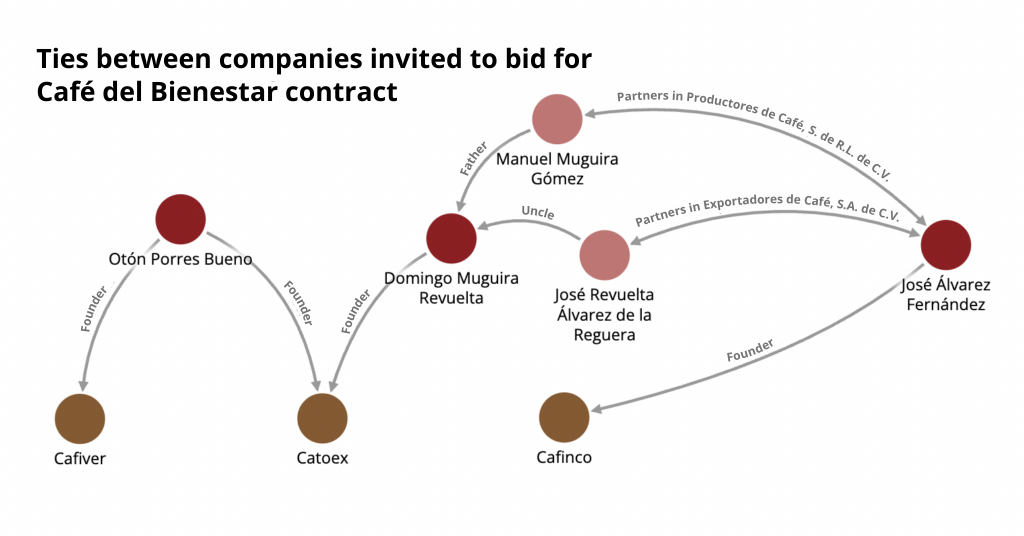
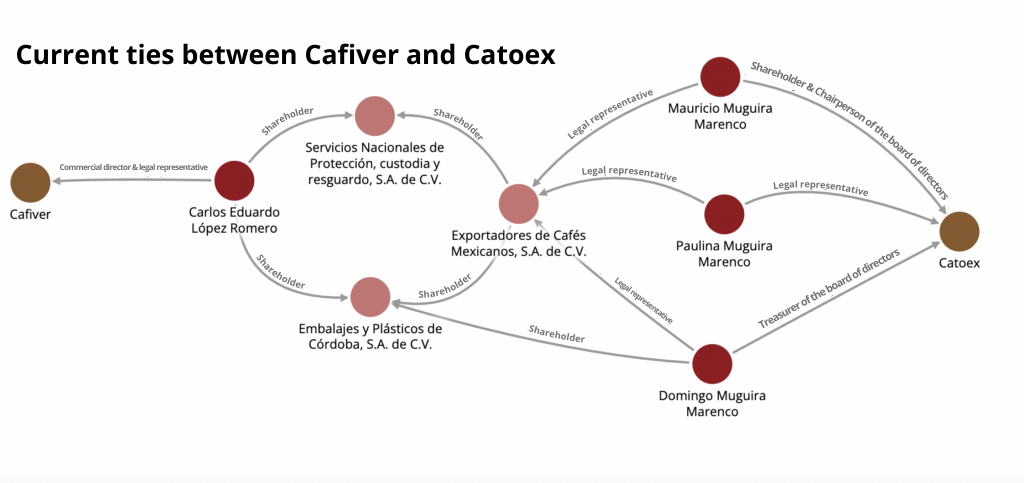
Muguira Revuelta died in 2019, but his children continue to run the business through Catoex: Mauricio Ricardo Muguira Marenco, as a shareholder and chairman of the board of directors; Domingo Muguira Marenco, as treasurer of the board; and Paulina Muguira Marenco, as the company’s legal representative.
Although the ties between the families that own Catoex, Cafiver, and Cafinco date back several decades, those relationships remain in place today through the heirs of each business dynasty.
For example, Cafiver’s current commercial director,18“Carlos Eduardo López Romero’s Profile,” LinkedIn, 2025, share.mayfirst.org/s/AHfWnAZeCJYTYmd. Carlos Eduardo López Romero, co-founded two companies — Servicios Nacionales de Protección, Custodia y Resguardo, S.A. de C.V., and Embalajes y Plásticos de Córdoba, S.A. de C.V. — in partnership with Exportadores de Cafés Mexicanos, S.A. de C.V.,19The two companies are Embalajes y Plásticos de Córdoba, S.A. de C.V. and Servicios Nacionales de Protección, custodia y resguardo, S.A. de C.V. See: “M4. Embalajes y Plásticos de Córdoba, S.A. de C.V.,” SIGER, 21 November 2011, share.mayfirst.org/s/DK9RX6xrdPjEctr; and, “M2. Servicios Nacionales de Protección, Custodia y Resguardo, S.A. de C.V.,” SIGER, 1 January 1999, share.mayfirst.org/s/KDHgtmwojkB6GzP. a company controlled by the Muguira Marenco family, the owners of Catoex.
A similar pattern emerges at Cafinco. The daughter of its founder, María del Carmen Álvarez Zardaín, co-founded Grupo Empresarial Pertenezco20“M4. Grupo Empresarial Pertenezco,” SIGER, 16 April 2013, Op.Cit. alongside Domingo and Paulina Muguira Marenco, Grupo Empresarial Porres — owned by Otón Porres Bueno —, and former Veracruz governor Javier Duarte de Ochoa, who was arrested in 201721“Javier Duarte fue capturado en Guatemala, confirma PGR,” Aristegui Noticias, 15 April 2017, aristeguinoticias.com/1504/mexico/javier-duarte-fue-capturado-en-guatemala-confirma-pgr. and sentenced to prison in 201822“Condenan a Javier Duarte a 9 años de prisión y el pago de 58 mil pesos,” Aristegui Noticias, 26 September 2018, aristeguinoticias.com/2609/mexico/condenan-a-javier-duarte-a-9-anos-de-prision-y-el-pago-de-58-mil-pesos. for criminal association and money laundering.
“In 2013, when I was governor of the state, I was approached by a group of businesspeople from my home region,” Javier Duarte said regarding his involvement in Grupo Empresarial Pertenezco.
According to Duarte, the entity was not conceived as a business consortium, despite the fact that its founders included multiple companies and entrepreneurs. He said the purpose of the venture was to build a private hospital, but the project collapsed after the group failed to raise the necessary funds. On those grounds, Duarte stressed that he is not a business partner of any of the other participants. “What the people involved do is independent of me,” he said.
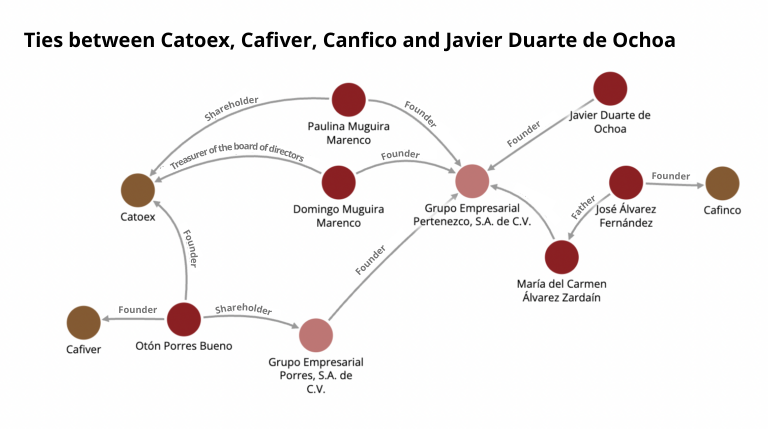
Beyond this, the network of companies linking Catoex, Cafiver, and Cafinco operates within a broader ecosystem that also includes suppliers previously flagged for irregularities. One of them is Empacadora La Merced, S.A. de C.V., which has been linked to irregularities in contracts with Segalmex.
According to journalist Georgina Zerega,23“Las claves del ‘caso Segalmex’: los multimillonarios desfalcos en el organismo creado para garantizar la alimentación de los más necesitados,” El País, 20 March 2023, Op.Cit. Empacadora La Merced secured contracts with Segalmex in 2020 to supply shredded meat, but failed to deliver goods equivalent to 2.7 million MXN (150,445 USD) despite having received payment.
Within this web of relationships, Eduardo Álvarez Zardaín, the current owner of Cafinco,24“M4. Cafés Finos de Córdoba, S.A. de C.V.,” SIGER, 21 February 2012, share.mayfirst.org/s/8WLtrg9S7ciaR5z.
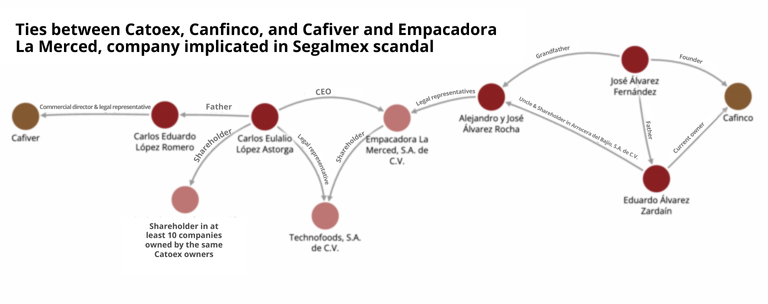
is both the uncle and business partner of José and Alejandro Álvarez Rocha.25The family and corporate ties were verified through online searches of birth certificates and corporate registry records. Both brothers have served as legal representatives of Empacadora La Merced,26“M2. Empacadora la Merced, S.A. de C.V.,” SIGER, 19 March 2019, share.mayfirst.org/s/AjqnyJHDKZZPDpc. as illustrated in the accompanying chart. The company’s chief executive officer,27“Carlos Eulalio López Astorga’s Profile”, Linkedin, 2025, www.linkedin.com/in/carlos-e-l%C3%B3pez-astorga-3b6954195/?originalSubdomain=mx; and, “Recomendación de Empacadora la Merced firmada por Carlos Eulalio López Astorga como director general,” Grupo Captor, 4 June 2020, share.mayfirst.org/s/n3e39twWHypwbmB. Carlos Eulalio López Astorga, has also acted as a legal representative of Catoex28“M10. Café Tostado de Exportación, S.A. de C.V.,” SIGER, 18 July 2017, share.mayfirst.org/s/tBGfqiNFfbTiBMT.
and as a business partner of its owners in at least 10 other companies. He is also the father of Cafiver’s current director, completing a circle that links the three companies through executive roles and family ties.
When asked about the allegations described above, Cafiver said that “Otón Porres has no relationship whatsoever with Café Tostado de Exportación (Catoex), which competes with Cafiver in national and international markets.” However, records from Mexico’s Public Registry of Commerce list him as one of Catoex’s founders.
The company also said that “there was no bidding process” for the Café del Bienestar contract and that it stemmed from a direct invitation by staff from the Secretariat of Agriculture and Rural Development (Sader), Diconsa, and Alimentación para el Bienestar, through Manuel Ochoa and Iván Rico. According to Cafiver, those public officials “visited Cafiver’s facilities on several occasions to request price quotes for the processing services they required (with the agencies supplying the green coffee).” Cafiver said it attributed the invitation to its position as Mexico’s leading coffee processor with fully Mexican-owned capital, as well as to the quality of its products and processes and its market presence. The company added that it was ultimately not selected to carry out the processing.
Cafiver also denied having any relationship with Empacadora La Merced.
Contractors for Segalmex and Diconsa, now reorganized under Alimentación para el Bienestar, have drawn sustained scrutiny from journalists and from administrative and criminal authorities in recent years. Segalmex was at the center of the largest corruption scandal of former president Andrés Manuel López Obrador’s administration, involving estimated losses of roughly 15,000 million MXN (8,358,063,915 USD) to the public treasury.
Despite the restructuring that created Alimentación para el Bienestar in January 2025, the agency responsible for Mexico’s food security programs has continued to award contracts to companies previously flagged for irregularities at the now-defunct Segalmex. This pattern suggests that the new institution has not put in place sufficient safeguards to prevent the recurrence of practices that were questioned in the past.
Among those companies are Marindustrias, S.A. de C.V., which this year received at least 33 contracts totaling 3,775,729.68 MXN (210,385 USD); La Italiana, S.A. de C.V., with 37 contracts totaling 11,629,916.40 MXN (648,023 USD); and Soluciones Logísticas Inteligentes, S.A. de C.V., which received at least one contract worth 18,139,386.11 MXN (1,010,734 USD), according to the Federal government’s procurement portal, ComprasMX.
The first two were flagged in an investigation by journalist Iván Alamillo of the organization Mexicanos Contra la Corrupción29“Proveedores de Diconsa pagaron ‘moche’ a través de empresa ‘fantasma’,” Mexicanos Contra la Corrupción, 13 December 2022, contralacorrupcion.mx/proveedores-de-diconsa-pagaron-moche-a-traves-de-empresa-fantasma. for allegedly paying bribes to obtain contracts at Segalmex. The third was flagged by Mexico’s Supreme Auditor (ASF)30“Auditoría De Cumplimiento Forense: 2023-1-08JBP-23-0400-2024,” ASF, 2023, www.asf.gob.mx/Trans/Informes/IR2023c/Documentos/Auditorias/2023_0400_a.pdf. for failing to document the delivery of services for which it was paid in 2023. In addition, it has been cited in press reports for alleged links to political figures and former officials at Segalmex.
In the case of Catoex, it is notable that, beyond securing the contract to process Café del Bienestar, the company is part of a network of firms and business figures — built by its founder and now maintained by his heirs — whose background and connections have also drawn public scrutiny.
Background of Catoex and its ties to Duarte
Catoex’s founder, Domingo Muguira Revuelta, was imprisoned in 1978 for defrauding the Mexican Coffee Institute (Inmecafe) by trafficking export permits for his own benefit. He also set up companies that were later used to divert funds from the National Lottery when it was headed by Carlos Salomón Cámara, his relative by marriage.31“El rey del café”, pieza clave en el escándalo de Salomón Cámara,” Proceso, 17 December 2001, www.proceso.com.mx/nacional/2001/12/17/el-rey-del-cafe-pieza-clave-en-el-escandalo-de-salomon-camara-63463.html. In addition, he was investigated by Spain’s Economic and Fiscal Crime Unit (UDEF) for allegedly participating in a money-laundering scheme that financed his coffee plantations in the states of Chiapas and Veracruz.
Beyond his role as a businessman, Muguira Revuelta was closely linked to local politics. According to the 2015–17 political party registry,32“Padrón de partidos políticos 2015-2017,” PNT, 2015-17, share.mayfirst.org/s/xYJSATc6BfwmPXp. he served as secretary for organization and political action within the Citizens’ Movement party. He also regularly attended public events and private meetings with influential figures from both the Institutional Revolutionary Party (PRI) and the National Action Party (PAN), some of whom later became his business partners.
“Don Domingo was my friend, I held him in great affection,” Duarte said of his relationship with Catoex’s founder.
Muguira Revuelta’s heirs have also built lives closely tied to the political class. For example, Paulina Muguira Marenco, daughter of Catoex’s founder, served as a local lawmaker from 2010-13 with the PRI,33“LXII Legislatura del Congreso del Estado de Veracruz,” Congreso del Estado de Veracruz, 2010, www.legisver.gob.mx/Inicio.php?p=histLeg&leg=62&ej=1&n=1&a%C3%B1o=2010. on a ticket backed by Javier Duarte de Ochoa’s campaign for governor of Veracruz.34“Cierre de campaña de los candidatos del PRI, Javier Duarte, Paulina Muguira y Francisco Portilla,” YouTube, 1 July 2010, www.youtube.com/watch?v=oHWZjemO4t0.
Moreover, she is married to Juan Lavín, a PRI mayor of the city of Córdoba from 2007-10,35“Lavín Torres acompañado de su esposa Paulina Muguira de Lavín,” Las Altas Montañas, February 2010, www.lasaltasmontanas.com/2010/02/lavin-torres-acompanado-de-su-esposa.html?m=0. who unsuccessfully sought a seat in the federal Chamber of Deputies for that district in 2018.
According to Javier Duarte, Paulina Muguira’s marriage explains why she became a lawmaker and one of his political allies. “It had more to do with politics than with friendship. It was primarily political. Juan Lavín, her husband, was mayor of Córdoba at the time, and the PRI’s top-rated candidate for local office, as I recall, was the head of the municipal social welfare agency (DIF), Paulina Muguira,” he said.
Another case is that of Alicia Muguira Marenco, who was married to Armel Cid de León Díaz, a PRI mayor of Fortín from 2014-17.36“Entregan la primera constancia de mayoría a Armel Cid, será alcalde de Fortín,” Al Calor Político, 9 July 2013, www.alcalorpolitico.com/informacion/entregan-la-primera-constancia-de-mayoria-a-armel-cid-sera-alcalde-de-fortin-119738.html. Their son, Armel Cid de León Muguira, has also served as an adviser to Mexico’s Senate.37“Contrato de prestación de servicios profesionales,” Senado de la República, 17 March 2017, transparencia.senado.gob.mx/obligaciones/LGART72/FRAC-XII/2016-03/13053.pdf.
On the other hand, members of the dynasty known as the Porres Group — present in both Catoex and its competitor, Cafiver — have also been linked to political power associated with what Mexico’s current governing movement calls the “old regime,” spanning both the PRI and the PAN.
For instance, Jaime Porres Bueno, brother of one of Catoex’s founders, was identified as a front man for Javier Duarte in the book Duarte, el priista perfecto(Duarte, the perfect PRI politician) by journalist Arturo Ángel.38“Duarte, el priista perfecto,” Nexos, 15 January 2018, www.nexos.com.mx/?p=35771.
Asked about this by phone, Duarte said his relationship with Porres Bueno had been one of friendship. He added that they stopped speaking after the corruption scandal that led to his imprisonment.
In addition to the allegations surrounding the companies invited to bid on the processing of Café del Bienestar, coffee growers have also pointed to shortcomings in the program’s design and implementation. For some producers, these flaws have led them to opt out of the initiative altogether, even though it was originally conceived to benefit them.
The promises of Café del Bienestar
One of the main grievances among coffee growers in Mexico has been that coffee prices are often dictated by intermediaries linked to large corporations such as Nestlé and Starbucks, two of the country’s largest coffee buyers.
Companies such as ECOM Agroindustrial Corp. Limited (ECOM), Neumann Kaffee Gruppe (NKG), and Louis Dreyfus Company B.V. (LDC) wield such market power that they can influence coffee prices and impose abusive practices, ranging from informal credit schemes and one-sided contracts to human rights violations, which many producers are forced to tolerate due to a lack of alternatives. This is documented in the report “Exploitation and Opacity: The Hidden Reality of Mexican Coffee in the Nestlé and Starbucks Supply Chains,”39“Exploitation and Opacity: The Hidden Reality of Mexican Coffee in the Nestlé and Starbucks Supply Chains,” Empower, 14 February 2025, empowerllc.net/wp-content/uploads/2025/02/Exploitation-and-Opacity-ENG-HD.pdf. published this year (2025) by Coffee Watch, Empower, and ProDESC.
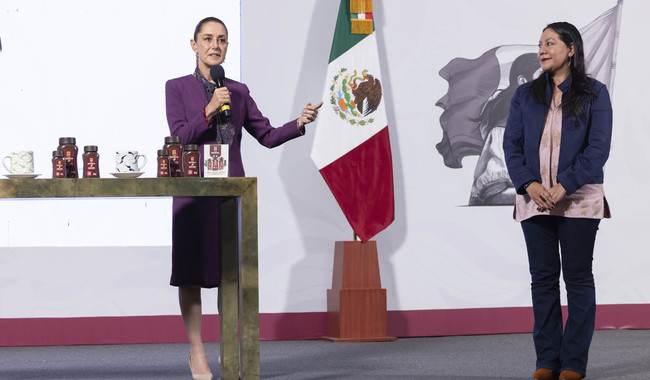
That is why, when President Claudia Sheinbaum announced the creation of Café del Bienestar in November 2024,40“Versión estenográfica. Conferencia de prensa de la presidenta Claudia Sheinbaum Pardo del 15 de noviembre de 2024,” Presidencia de la República, 15 November 2024, www.gob.mx/presidencia/articulos/version-estenografica-conferencia-de-prensa-de-la-presidenta-claudia-sheinbaum-pardo-del-15-de-noviembre-de-2024. the initiative introduced for the first time a direct purchasing scheme aimed at reshaping the relationship between small-scale producers and intermediaries.
The initiative was presented as an add-on to the Rural Supply Program, which included government-set purchase prices for coffee, as well as its processing and distribution through the Bienestar store network, formerly known as Diconsa.
Until then, although programs such as Sembrando Vida provided support to coffee growers and other agricultural producers, there were no public initiatives designed to facilitate the processing, distribution, and commercialization of these products within the State-owned store network.
These stores sold only instant coffee brands such as Nescafé and Café Legal, and one concern raised by coffee growers interviewed for this investigation was that the president’s announcement could ultimately benefit large corporations rather than small producers, particularly if subsidized coffee were to end up in the hands of multinational companies.
The operating rules of the Rural Supply Program were published in January 2025,41“ACUERDO por el que se dan a conocer las Reglas de Operación del Programa de Abasto Rural a cargo de Diconsa, S.A. de C.V. (DICONSA) para el ejercicio fiscal 2025,” Alimentación para el Bienestar, 24 January 2025, Op.Cit. including a chapter on the “Transformation for Well-being” component, which formalized the announcement made by Sheinbaum two months earlier.
The program authorized Diconsa to develop its own brands and market them through the State-owned store network. It also designated the processing of coffee, cocoa, and honey as a priority, initially in the states of Yucatán, Tabasco, Veracruz, Oaxaca, Chiapas, Puebla, and Guerrero.
For coffee purchases, the program established that beneficiaries would be small-scale producers, defined as those farming no more than five hectares, who would be paid 75 MXN (4.18 USD)per kg of Arabica parchment coffee, 65 MXN (3.62 USD)per kg of Arabica natural coffee, and 55 MXN (3.06 USD)per kg of natural Robusta coffee, up to a maximum volume of 500 kgs per producer.
However, the price set for parchment coffee proved unprofitable for many growers, who reported that production costs were higher and that they could earn more by selling to other buyers.
“They got the pricing wrong,” said Arturo García Jiménez, a coffee producer in Atoyac, Guerrero. “Parchment coffee should have been priced at 130 MXN (7.24 USD), but they were buying it for 75 (4.18 USD).”
“I can tell you exactly how much it costs me to produce a kilo of parchment coffee: 110 pesos (6.13 USD),” said Cirilo Elotlán Díaz, a coffee producer in Veracruz and a member of the Coatepec Regional Coffee Council.
After several months of operating under these prices, Alimentación para el Bienestar published an amendment to the program’s operating rules in October 2025,42“ACUERDO por el que se modifica el diverso por el que se dan a conocer las Reglas de Operación del Programa de Precios de Garantía a Productos Alimentarios Básicos para el ejercicio fiscal 2025, publicado el 30 de enero de 2025,” Alimentación para el Bienestar, 16 October 2025, Op.Cit. raising the price of Arabica parchment coffee to 100 MXN (5.57 USD)per kg. The revision clarified that these amounts would function as a base price and that, if market prices during the harvest season exceeded the base amounts, a one-time compensatory payment of up to an additional 15 percent would be made at the end of the harvest period.
“The main problem here is how reliable this really is,” said Cirilo Elotlán, from Veracruz. “Right now, there’s a lack of transparency, but that’s somewhat understandable because, as I’ve said, this is a pilot program. They’re conducting analyses and gathering data, and if they adjust it year after year, that’s interesting, because that’s exactly what we’re asking for: a tailor-made solution.”
The revisions also included an increase in the maximum procurement volume to 750 kgper producer, while the overall purchase target remained unchanged from the original plan: a total acquisition of 2,077 tons of coffee,43“Mecánica operativa del componente transformación para el Bienestar del Programa de Abasto Rural ejercicio fiscal 2025,” Alimentación para el Bienestar, 24 January 2025, www.gob.mx/cms/uploads/attachment/file/984127/Meca_nica_Operativa_Componente_Transformacio_n_DAJ_12.03.2025_V.Publicada__1_.pdf. 177 tons of Arabica parchment coffee, 1,300 tons of Arabica natural coffee, and 600 tons of natural Robusta. Most of this volume was slated to be purchased in Guerrero (1,300 tons), followed by Veracruz (360 tons), Oaxaca (300), and Puebla (117).
Beyond the prices paid per kilogram, another concern raised by coffee growers was that 2,077 tons represented a negligible volume for a country that produced 1,056,306 tons of coffee cherry in 2024,44“Escenario mensual de productos agroalimentarios,” Secretaría de Agricultura y Desarrollo Rural, 15 August 2024, Op.Cit. the term used for freshly harvested coffee fruit.
“The program is marginal, its procurement volumes are minimal compared to national production,” said Arturo García Jiménez, a producer at Cafés Atoyac in Guerrero. “The positive side is that Nestlé was displaced. The irony now is that Café del Bienestar isn’t arriving, so there’s no coffee in the Diconsa stores.”
This problem is compounded by the coffee processing process itself, which significantly reduces the volume initially purchased, first when the husk is removed and later when the coffee is converted into instant coffee.
According to García Jiménez, the program purchases coffee beans with the husk intact; once removed, the weight is reduced by half. From there, approximately 2.8 kgof coffee are required to produce one kg of instant coffee, further reducing final output.
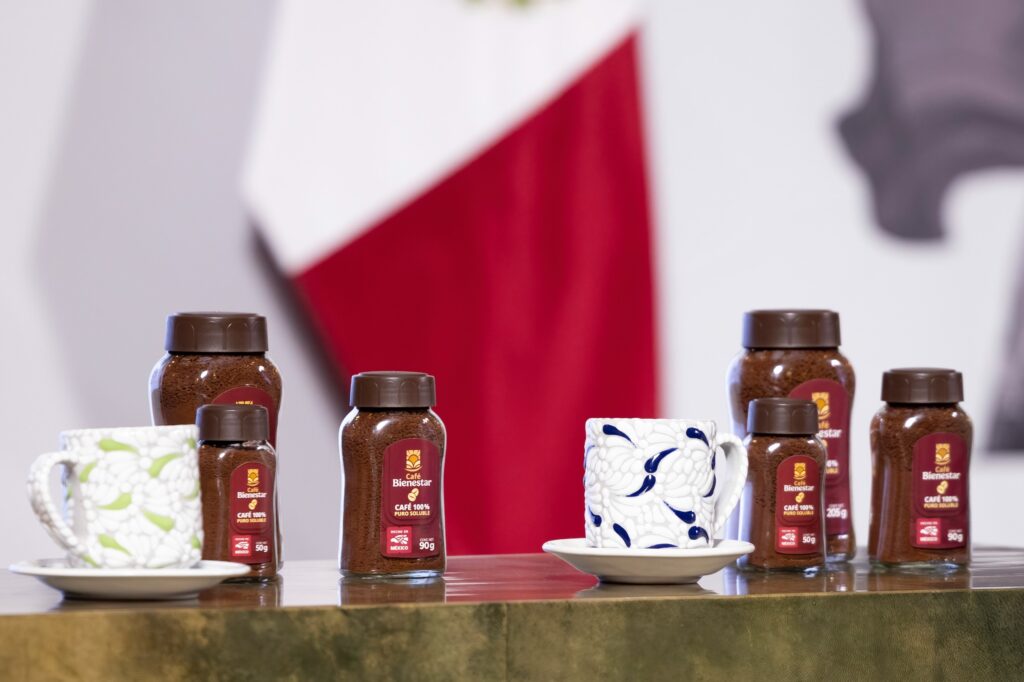
As of August 2025, of the 918.67 tons of coffee procured,45“Tierra y Bienestar – Publicación informativa,” Alimentación para el Bienestar, August 2025, share.mayfirst.org/s/RYYxkbmpwaTjfbz. production had yielded 110,004 jars of 90-gram instant coffee, 99,000 jars of 50 grams, and 23,808 jars of 205 grams,46“Response to a Freedom of Information request, file number 340012200009825,” PNT, 21 August 2015, share.mayfirst.org/s/Eo8zmdKZ2zRPEfJ. to be distributed across a network of more than 25,400 Bienestar stores.
If distributed evenly, each store would have received only nine jars of coffee.
Some of the growers consulted also reported concerns about the quality of the instant coffee sold under the Bienestar label, noting smaller crystals and a powdery texture, features they associated with lower quality and cheaper processing methods.
By contrast, freeze-dried coffee, considered the highest-quality method for instant coffee, produces larger, more solid crystals.
Unlike leading instant coffee brands, Café del Bienestar does not specify the processing method on its labeling.
Opportunities for improvement, according to coffee growers
Despite the changes published in October, including raising the price of parchment coffee from 75 MXN(4.18 USD)to 100 MXN (5.57 USD)per kg and introducing a potential year-end adjustment of up to 15 percent to narrow the gap between production costs and purchase prices, it remains unclear how this adjustment will operate or what criteria will govern its application.
Until pricing issues are resolved, some producers warn that it may be difficult to encourage more growers to sell larger volumes to the program.
“We see the program as a positive government initiative,” said José Juárez, a coffee producer from Chiapas. “However, the methodology is not the most appropriate, because it doesn’t address pricing or the deeper structural problem: helping producers organize, build productive capacity, add value, and connect directly to the market with government support.”
“It would be a major opportunity for Café del Bienestar to partner with producers or cooperative enterprises in the social sector to establish a processing plant capable of carrying out these industrialization steps,” Juárez added.
Arturo García Jiménez, a coffee grower from Guerrero, agrees. “Viewed as a pilot program, it is a good initiative. But producers need to be involved so it doesn’t become a simple buy-sell operation,” he said. “The program should expand to other institutional markets and provide support or linkages so producers can develop and take ownership of the entire value chain — plantation rehabilitation, technical assistance, productivity improvements, agroecological practices, value addition, and financing. Only with this comprehensive approach can the real development of this important yet marginalized sector be achieved.”
For Fernando Celis Callejas, general advisor to the National Coordinator of Coffee Organizations (CNOC), the program’s direction could improve by involving producers directly in coffee processing and the value chain, a move he says would be more consistent with the stated goal of supporting small-scale producers, particularly those from indigenous communities.
“Our position is this: if the government is going to buy coffee from indigenous and small producers and sell it as instant coffee, it could process it using the infrastructure of small-producer organizations,” Celis Callejas said in an interview.
In Oaxaca, for example, an organization made up of indigenous coffee growers has been attempting to do so for more than three years. The State Coordinator of Coffee Producers of Oaxaca (CEPCO), along with ten other organizations from several states affiliated with the CNOC, has expressed both the capacity and the interest to process coffee for Diconsa and Segalmex. For this reason, according to Celis Callejas, those responsible for Café del Bienestar were aware that alternatives to Catoex, Cafiver, and Cafinco existed.
According to Celis Callejas, these organizations had already reached an agreement to sell organic instant coffee to Segalmex under the “Fértil” brand at a lower price than Nestlé’s, “but at the last minute it was canceled due to agreements between officials and certain councils representing Diconsa’s rural stores.”
However, this was not the only attempt by these coffee organizations to become suppliers to the Federal government. During the first quarter of 2025,47“Informe de comisión (versión pública),” Secretaría Anticorrupción y Buen Gobierno, 20 March 2025, viaticosipot.buengobierno.gob.mx/pdf/Informes/2025/2025-I-0129.pdf. CEPCO held meetings with the Secretariat of Anti-Corruption and Good Governance to seek inclusion as a supplier, according to records reviewed on the National Transparency Platform.
“There is communication between officials and the producer sector with those responsible for the program, because they obviously consult on how the program is performing, pricing, and so on. So if they are going to process instant coffee, there is an organization here that already has the infrastructure,” he said.
Thus, while small producers, who should be at the core of the program, continue to receive prices that barely cover their production costs, the Café del Bienestar contracts were awarded, at inflated prices, to the same actors as always: prominent businesspeople with questionable reputations and deep ties to corrupt politicians.
In addition to contacting Cafiver and former Veracruz governor Javier Duarte de Ochoa, this team of journalists reached out to Catoex, Cafinco, Empacadora La Merced, and the head of Alimentación para el Bienestar, María Luisa Albores; none had responded by the time of publication.
UPDATE 12/11/25: ALIMENTACIÓN PARA EL BIENESTAR RESPONDS
The communications department of Alimentación para el Bienestar responded to a questionnaire on Wednesday followingthe publication deadline, which had previously been sent by the Empower Journalism and Aristegui Noticias.
In the document, available here in Spanish, the agency states that it has no record or reference of any producers having expressed dissatisfaction with the prices paid this year for coffee purchased under the Café del Bienestar program. It also clarifies that prices were set in November 2024, when market conditions differed from those currently prevailing.
They also said that, for the time being, freeze-drying, a technique that, according to the reporting, produces higher-quality coffee, is not used in Café del Bienestar because of its higher production costs and because “there is only one company in the country that provides this service.”
Regarding the decision to award the contract to Catoex, the agency said that “there are few companies that provide solubilization services to third parties” and that Catoex met all the criteria predefined by the program.
With respect to the alleged association among the three companies invited to submit quotes, the agency said it was “unaware of the alleged association” and stated that the process was based on the fact that the Law on Public Sector Procurement, Leasing, and Services allows for direct awards when purchases are made for direct commercialization or for submission to productive processes.
The agency was also asked why the State Coordinator of Coffee Producers of Oaxaca (CEPCO) was not considered for processing the coffee. It argued that “no official request was received” and that CEPCO “has not been identified as having the technical capacity” to do so.
Alimentación para el Bienestar also said it “has no knowledge of the commercial conditions or agreements [Catoex]maintains with other clients,” but noted that the contract awarded includes “the handling and conditioning of the coffee prior to its transformation,” as well as the transportation of the product to operational units or central warehouses, standard elements in procurement processes.
Finally, the agency said it continues to award contracts to companies accused of embezzlement from Segalmex “because the oversight authorities have not notified it of any disqualification or sanction against these companies.”
Lasts Posts
11 de December de 2025
Mexican Coffee Program Awards Millions to Associates of Jailed Ex-Governor

14 de August de 2025
The Discreet Business Network behind Mexico’s Alimentación para el Bienestar